

Thursday Thread 26.01
How small, repeated cues become the rails of a well-lived life
If you read Domo Futu through 2025, you lived the daily prompts practice with me. You read a short prompt each day, and you made time for reflection in the middle of ordinary life. I am grateful for that attention, because attention is the real substance of this project. I am also grateful for the replies, the silent readers, the people who told me they used the prompts as a small daily reset, and those who had a favorite they re-visited regularly.
In 2026, I am changing the cadence. I will publish prompts once each week, on what for me will be a Thursday. Each Thursday Thread will link to seven archived prompts, and it will offer one theme to carry into the days ahead, one personal anecdote that (hopefully) makes the theme concrete, and one external reference that widens the lens. I am writing this first thread as a kickoff for the new year, and as an invitation to build a weekly practice that can support the year ahead.

Prompts for the week
Day 1: Home — https://domofutu.substack.com/p/reflecting-on-home
Day 2: Imbalances — https://domofutu.substack.com/p/embracing-imbalances
Day 3: No — https://domofutu.substack.com/p/no
Day 4: Sleep — https://domofutu.substack.com/p/restful-spaces
Day 5: Play — https://domofutu.substack.com/p/prompt-0105-the-power-of-play
Day 6: Growth — https://domofutu.substack.com/p/prompt-0106-environment-for-growth
Day 7: Freedom — https://domofutu.substack.com/p/prompt-0107-time-space-and-freedom
The Thread
This week has one constraint that touches everything else.
Your environment shapes you before your willpower.
Your home is a set of cues that trains mood, productivity, and even self-concept. That is why the “home” prompt frames living spaces as silent witnesses that influence well-being, and why it argues for small, thoughtful adjustments rather than dramatic overhauls.
Your personality does the same thing. The “imbalances” prompt articulates the truth that no one is evenly distributed across traits, and it treats those imbalances as potential advantages that need direction. The problem is rarely the trait itself, because the real problem is usually the unmanaged cost of the trait.
Your social world adds another layer. The “no” prompt re-frames rejection as redirection and argues that reality is often kinder than our imagination. It also makes a practical claim that bold asking builds confidence, opens unexpected alternatives, and increases clarity in relationships when you keep respect and detachment in view.
Your bedroom is a micro-environment that deserves its own attention. The “sleep” prompt treats the bedroom as a retreat, then points to concrete levers like comfort, lighting, and air circulation, because small changes there can ripple into mental clarity and emotional resilience in your waking life.
Your play is a signal, rather than a luxury. The “play” prompt makes the case that joy can be a catalyst for creativity, and it suggests that you should notice where joy shows up in the body, because that bodily cue can guide you back toward what replenishes you.
Your growth depends on the environments you choose. The “growth” prompt distinguishes between deliberate challenges, unexpected tests, and supportive spaces, then argues that strength comes from effort, creativity comes from adaptation, and resilience improves when you are surrounded by people and settings that uplift you.
Finally, your freedom is a design problem as much as a mindset problem. The “freedom” prompt names three failure modes: over-commitment, reactive scheduling, and mental clutter; and it answers them with priority reviews, structured downtime, simplified spaces, and buffer zones that protect flexibility.
The mechanism that links all seven prompts is repetition. Small cues repeated daily become rails. Rails become habits. Habits become a life that feels either supported or strained.
The bottleneck to such habituation is rarely knowledge, but the default setting you did not choose.
A principle you can carry into the week is that freedom grows when you set one helpful default and protect it with one clear boundary.
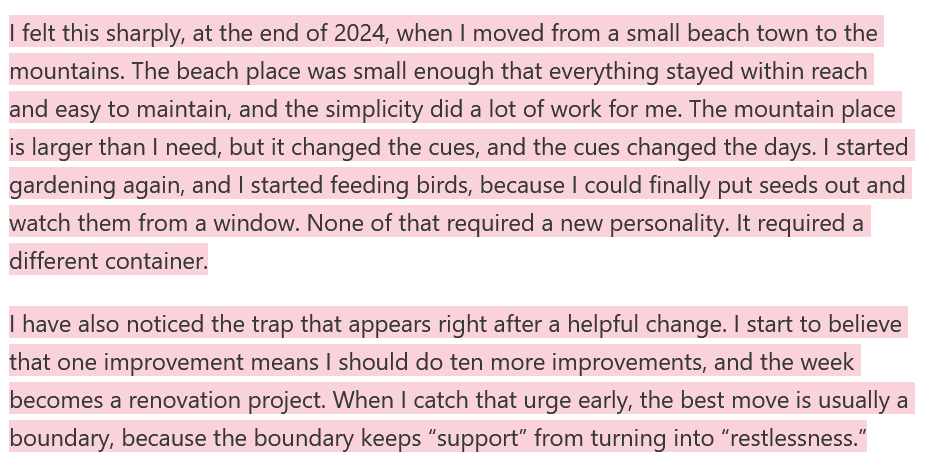
If you want a clean start to the year, you can begin with one corner that reduces friction, and one decision that stops the corner from becoming a hobby.
What is one part of your environment that currently asks too much of you?
Further Reading
A book that fits this week is Essentialism by Greg McKeown, a book I read in a single sitting, because I could not put it down.
McKeown’s useful idea is that selective commitment is a precondition for real freedom. When you say yes reflexively, your calendar becomes a record of other people’s priorities. When you learn to tolerate no, and when you practice asking boldly without attaching your identity to the outcome, you can build a schedule that reflects your values.
This matters for the week ahead because the prompts are all pointing to the same move. You can curate spaces. You can direct traits. You can design sleep. You can schedule play. You can choose growth environments. You can build buffer zones. However, none of those choices survive without a clear yes and a clear no.
Practice for the coming week:
Goal: You will create more time, space, and freedom by changing one default each day and defending it with one boundary.
Protocol: You will set a timer for ten minutes each day, and you will make one small change that supports the day you want to have. You will stop when the timer ends, because stopping is part of the practice.
On Day 1, you will clear one surface that you see often, because a calmer visual field reduces mental clutter.
On Day 2, you will name one personality imbalance that has helped you, and you will write one guardrail that reduces its cost.
On Day 3, you will make one bold ask that you have postponed, and you will let reality answer rather than letting fear keep you from asking.
On Day 4, you will improve one sleep variable in your bedroom by changing comfort, lighting, or air circulation.
On Day 5, you will schedule one playful activity and treat it as a real appointment, because joy is a resource that deserves a slot on the calendar.
On Day 6, you will choose one growth challenge that is specific and repeatable, and you will place it in an environment that requires your best effort.
On Day 7, you will create one buffer block on your calendar and protect it, because flexibility needs space to exist.
Track: You will rate “My day felt supported” from one to five each night.
Stop rule: You will reduce the daily action to two minutes if you notice irritability, perfectionism, or compulsive tracking.
Via negativa: You will not add a new commitment this week without a twenty four hour pause.1
A new year does not require a dramatic reinvention, because it can begin with a single chosen default. A good week does not require heroic discipline, because it can begin with a small environmental shift that makes the right thing easier.
What is one default you can change today that will make the next seven days easier to live well?
Via negativa is a “subtraction first” approach to improvement, where you focus on removing what reliably harms or distracts you before adding anything new. In practice, it means asking, “What can I remove this week that would make everything else easier?”