

Intelligent Tinkering
Somewhere between the Enlightenment’s fetish for reductionism and Silicon Valley’s love affair with “disruption,” we forgot the first rule of intelligent tinkering: don’t throw out the parts just because you don’t know what they do.
Aldo Leopold—ecologist, philosopher, and not incidentally a man who knew his way around a forest—put it beautifully:
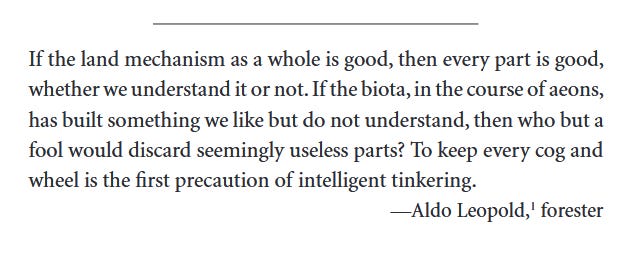
And why? Because nature doesn’t label the important stuff in neon. Sometimes, the thing that looks useless is holding the whole ecosystem together like a social introvert at a chaotic family reunion.
The Trouble With Tinkering
The temptation to "optimize" what we don't fully understand has always been part of the human project. It's what gave us brilliant innovations like agriculture and tragic experiments like the cane toad in Australia.
You see it everywhere:
In ecology: eliminate one “pest” species, and suddenly your crops are overrun by something worse.
In medicine: suppress one symptom, and three more sprout like hydra heads in a pharmaceutical myth.
In economics: regulate one market inefficiency, and somewhere a black market or moral hazard is born.
All of this might be forgivable—if we approached systems with the reverence of a watchmaker. But instead, we approach them like we’re playing Operation after three Red Bulls. And every time we remove a piece, we’re shocked that the buzzer goes off and the patient looks worse than before.
The Ecosystem Isn’t Broken
Leopold reminds us that complex systems evolve for reasons beyond our comprehension, and often beyond our imagination. The biota—meaning all living things in a region—didn’t hold a focus group and decide to assemble a wetland. It emerged. It self-organized. It worked—long before we showed up with bulldozers and a zoning permit.
In short: just because something looks useless doesn’t mean it is. In fact, in a complex system, the less you understand a component, the more cautious you should be about removing it.
That’s true for cogs in an ecosystem.
It’s true for feedback loops in a climate system.
And it’s especially true for policies in an economy.
From Leopold to Hazlitt to the Cell
Hazlitt tells us that every economic action has seen and unseen consequences. Leopold says the same of land. They’re singing the same tune, just with different instruments.
In both cases, the real danger comes from linear thinking applied to nonlinear systems. You don’t prune an organism like you do a spreadsheet. You don’t streamline a food web. And you sure as hell don’t optimize a coral reef.
In The Great Mental Models, we learn that cooperation—not domination—is nature’s power play. Mitochondria didn’t get absorbed into early cells because one side had a better quarterly report. They cooperated because their partnership expanded the possibility space, allowing complexity to flourish.
For more about these connections, check out:

That’s the lesson Leopold is whispering beneath the trees: Tinker, yes—but with humility. Keep the parts. Especially the ones you don’t understand.
Modern Implications: Beware the Clean Sweep
Today, we walk into ancient systems—ecological, institutional, cultural—with the swagger of a man who just read one blog post on productivity. We reorganize, consolidate, cut, rebrand. We "disrupt." Then we act surprised when the system collapses.
We call it progress when we cut the arts from schools.
We call it efficiency when we clear the underbrush.
We call it bold reform when we gut the regulatory frameworks designed by people who still remembered the last collapse.
But nature doesn’t care what we call it. Nature just recalculates—and often not in our favor.
Closing Notes from the Forest
Leopold saw the danger before most of us could spell “biodiversity.” He knew that humans are excellent at changing systems and terrible at predicting the second-order consequences of those changes.
So here’s a corollary to Leopold’s law: When you're dealing with a system older than your species, maybe don’t start yanking wires just because you don't see sparks.
Hold onto the cogs. Keep the wheels. Trust that the parts you don't understand may be doing more than you realize. That’s not technophobia—it’s technoreverence.
And it’s the only kind of tinkering worth doing.
